
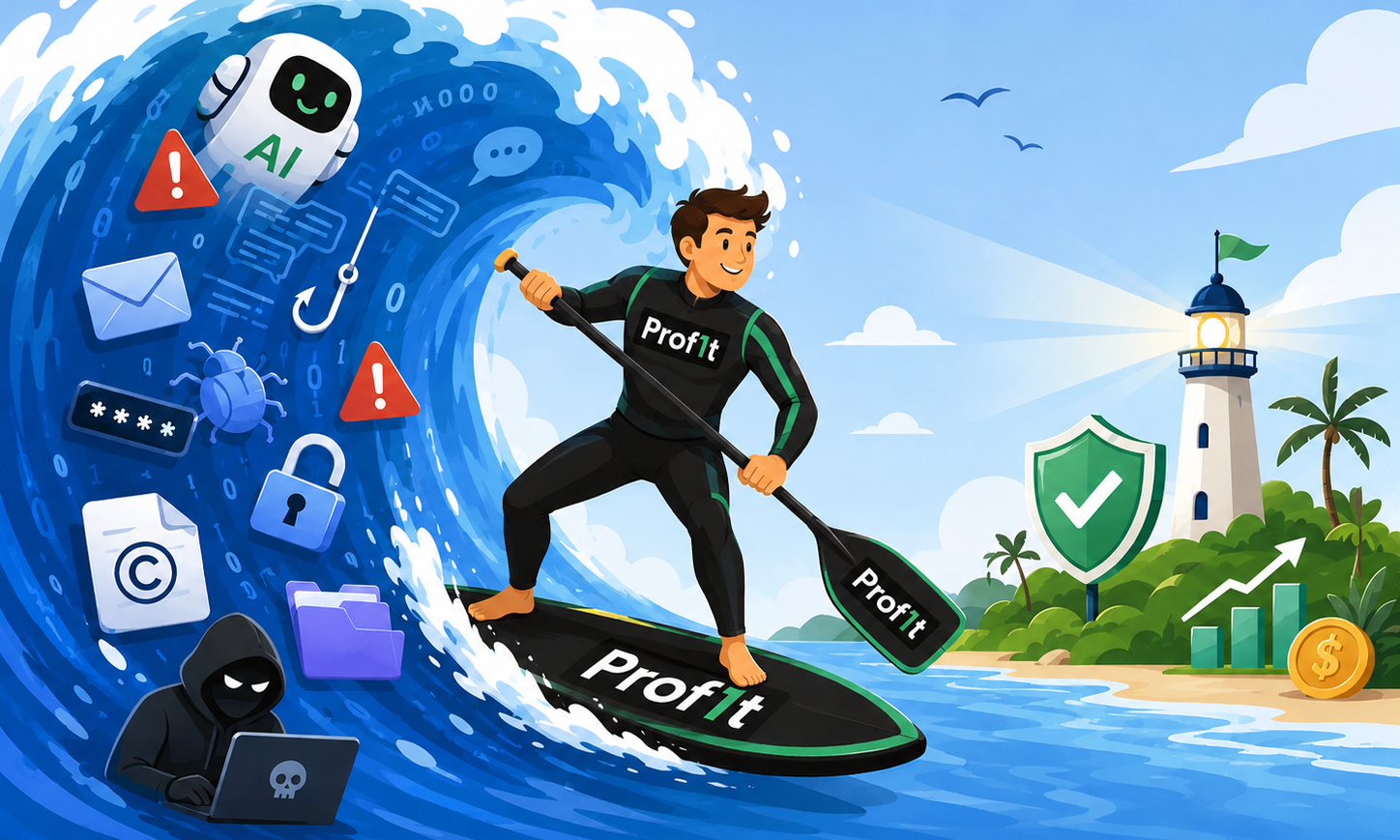
With the rapid acceleration of Artificial Intelligence globally, you have likely noticed a massive surge in AI vendors offering "magical solutions", incredibly quick turnarounds, and low cost software fixes. It sounds incredibly enticing — plug in an AI tool, automate a massive workflow overnight, and cut costs instantly.
As your trusted software solutions partner since 1999, it is our responsibility to look past the marketing hype and give you an objective, clear perspective at what is happening in the market, including the severe hidden risks of these "quick-fix" AI projects, and how we can safely build the future together.
1. The Hidden Risks of the "Quick-Fix" AI Approach
When an outside vendor promises to replicate or "add a quick AI layer" to your existing systems, they often gloss over critical technical and legal vulnerabilities unique to South African law in particular:
- The Intellectual Property Vacuum: Under Section 21 of the South African Copyright Act 98 of 1978, an "author" must be a human creator for copyright ownership to legally vest. Purely AI-generated code or systems face an insurmountable hurdle in establishing ownership, meaning they reside in the public domain where anyone, including your competitors, can legally duplicate them.
- Severe POPIA & Cybersecurity Risks: Some vendors may ask for database access, data warehouse access, API keys, or user logins to "train the AI on your data." Opening our software and your core infrastructure to unverified third-party AI agents introduces catastrophic vulnerabilities to networks. Under the Protection of Personal Information Act (POPIA), your business bears absolute liability for securing consumer data. Sharing logins or backend access with unvetted systems exponentially increases your exposure to third-party data leaks, resulting in severe regulatory fines or reputational damage.
- The Danger of "False Law" and Hallucinations: AI platforms notoriously suffer from "hallucinations" — subtle logic flaws that look correct on the surface but are completely fabricated. This isn't theoretical; South African courts have already seen real-world cases where legal professionals blindly trusted AI outputs that generated entirely false legal precedents. In business software, these logic flaws lead to massive downstream bugs and corrupted calculations.
2. The Unforeseen and Unpredictable Costs of AI
The initial pitch from a standalone AI vendor is delivery in days and that it is incredibly cheap. What they don't show you is the ongoing operational impact and cost:
- The "Abandonment" Cost (Real-World Experience): We have already seen this cycle play out first-hand. A number of our clients have spent significant budget adopting third-party AI tools, only to use them briefly before uncovering structural flaws, inaccurate outputs, or hidden operational bottlenecks. Ultimately, they abandoned the projects or have severed the vendor relationships entirely, absorbing the financial loss and embarrassment.
- The "Token" Pricing Trap: Unlike traditional software with predictable licensing, advanced AI runs on consumption metrics (tokens/API calls). As your business processes more data, your monthly AI processing bills can spike unpredictably and exponentially without warning. Here is one article illustrating this:
Mystery company accidentally blew $500 million on Claude AI in a single month — failed to put usage limit on licenses for employees - The Integration and Maintenance Black Hole: Getting an AI tool to work in a sandbox is easy. Mapping it to your actual, everyday business rules, workflows, operating procedures, legacy data structures, and edge-case exceptions requires massive, expensive custom engineering that "quick-fix" vendors rarely have resources or stick around to support.
3. The "Layoff Boomerang" is Happening
- Astronomical Compute Fees: Replacing human salaries with AI licenses and API fees frequently backfires. Cloud compute costs and large language model (LLM) processing bills scale exponentially with usage, often exceeding an employee's salary.
- The "Undo Button": In many fields — particularly software development, digital marketing and customer support — AI models frequently produce inconsistent, generic, or flawed outputs that require hours of expensive human supervision and correction.
- Loss of Institutional Knowledge: Laying off workers causes a drain on critical human skills like judgment, context, and complex problem-solving. Nearly one-third of HR leaders report struggling to recover the institutional knowledge they lost during initial AI restructuring.
4. Why Co-Authoring AI with Your Established Software Partners Matters
Software solutions are not just lines of code, they are a digital blueprint of your company’s unique workflows, built and refined over decades.
When you introduce AI, it shouldn't be a standalone patch — it should be a strategic building block integrated seamlessly into the software systems you have already heavily invested in.
- Context is King: A third-party AI company may understand algorithms, but they do not understand your business. We understand your structures, your workflow history, and your specific industry nuances.
- The Guardrail Model: When we build or integrate AI modules, we do so within a closed, secure enterprise environment. This guarantees that your proprietary data is strictly insulated, never leaked to public training models, and fully protected under existing intellectual property laws.
- Predictable Stability: By embedding AI directly into our platform you already rely on, you bypass the risk of broken integrations, enjoy centralized system security, and benefit from predictable, enterprise-tier cost structures.
What We Are Doing in Terms of AI
We aren't watching the AI revolution from the sidelines, we are actively engineering it to serve your business safely.
We are embracing AI, we have the necessary skills and are highly excited about these innovations. We have a responsibility to inform our clients and we refuse to compromise the security, legal compliance, or structural integrity of your business for flashy headlines and for being uninformed.
Our development team is currently working on leveraging secure, enterprise-grade AI frameworks designed to serve as powerful building blocks for our core products. Our focus is on high-value, zero-risk automation: Like code generation, quality assurance, code and architecture review tools, advanced data insights, predictive workflows, predictive allocations, minimising loss, measured against industry standards and automating reporting — all built directly onto the stable, battle-tested foundations of the software you use today.
If you are being approached by AI vendors and want an objective technical assessment of what they are offering, please reach out to us first. Let's rather evaluate together to ensure your business stays protected, stable, and truly innovative.